

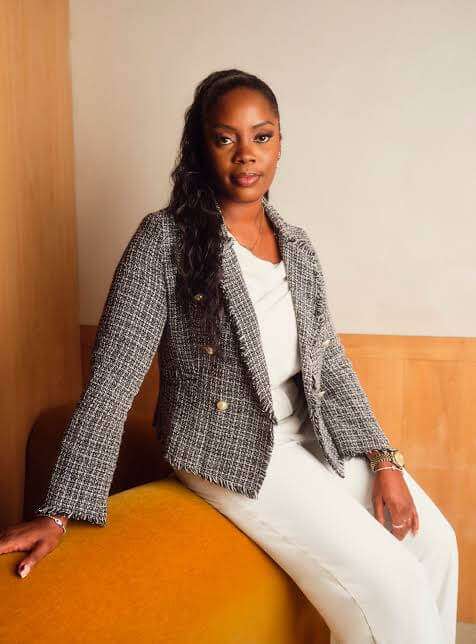
As part of the Morning Lazziness series highlighting empowering women who are making a remarkable impact with their ideas, I had the pleasure of interviewing Ahanna Anaba — an entrepreneur, brand strategist, and finalist for this year’s Black British Business Awards.
Ahanna Anaba is a trade finance leader passionate about connecting people, ideas, and opportunities to build inclusive systems. Born in Nigeria and raised across the Netherlands, Ghana, and the UK, her multicultural background shaped her global outlook and commitment to championing underrepresented voices.
She is Head of Sales and Partnerships at Finverity, where she became the company’s first female and youngest management hire. Ahanna leads commercial strategy across Africa, the Middle East, and Europe, helping banks and financial institutions digitise working capital solutions and expand SME access to finance. Before Finverity, she led the transactions team at Africa’s first deal-origination platform, managing $1.3 billion in opportunities and closing $390 million in cross-border deals.
In 2023, she founded the Women in Trade Network, which has brought together over 600 senior women leaders across 16 countries and hosted international events in Lagos, Nairobi, London, and Cape Town. She also chairs the MSME Trade Finance Working Group under ITFA and leads the Africa Working Group under TFCOP, advancing solutions to close the $2.5 trillion global trade finance gap.
A frequent speaker on trade, digital transformation, and gender inclusion, Ahanna has been recognised by Brummell Magazine, Global 100 Women in Leadership, YouTube’s Future Leaders lists and the Black British Business Awards.
In this interview, she talks about the obstacles she’s overcome, the milestones she’s achieved, and the wisdom she’s gained along the way.
What first sparked your interest in trade finance and international business?
I started my career by joining a startup as its first hire. As an engineering graduate, those early years were a crash course in resilience and creativity! Through hands-on experience, I witnessed the challenges African businesses face in accessing capital and that’s what first sparked my interest. At the time, trade finance was a very small part of my portfolio, but the COVID-19 pandemic changed everything.
Suddenly, the world’s interdependence was clear: coffee from Colombia, flowers from Kenya, and countless other goods we often take for granted were disrupted. With borders closed and travel limited, most of the deals I worked on became trade-related, and I began to truly appreciate how essential finance is to keeping goods moving across borders.
For me, trade finance became more than just a financial product. It is a product that creates lasting impact in communities around the world, affecting everything from the kind of coffee available at Starbucks, to the cost of the electronics you use for work every day.
How has your business evolved since its launch, and what key decisions have helped drive that growth?
When I joined Finverity, the mission was clear: transform supply chain finance for everyone. What started as a vision has since grown into a global platform, powering digitisation for banks and financial institutions across Africa, the Middle East, and Europe. In just a few years, we’ve expanded into 11 markets, scaled our client base, and helped deliver working capital solutions that directly support real businesses.
Two decisions have been central to that growth. The first is staying endlessly curious about our clients. Rather than assuming what banks or businesses need, we’ve invested time in understanding the realities of each market, the pain points of regional players, and the nuances of local regulation. That curiosity has shaped the way we build, keeping us flexible and client-focused rather than rigid and product-led.
The second has been choosing to design for local and regional institutions, not just global banks. Too often, technology is built for the largest players and then “scaled down.” We flipped that thinking by tailoring solutions to regional markets, making them fast to implement, cost-efficient, and adaptable. This decision has helped us win trust, build long-term partnerships, and, in some cases, help clients become first movers in their own countries.
You’ve worked across the UK, Africa, and Europe—how has this global perspective shaped the way you approach business challenges?
Living and working across different regions has taught me that context is everything, but also that people everywhere share far more in common than we often think. That perspective has shaped how I approach challenges: listen first, adapt strategies to local realities, and never lose sight of the bigger picture.
It’s easy in business to view companies as abstract entities, but people are at the heart of every company and every deal. For me, the questions are always: how well can I work with the people in this organisation, and how well can our partnership serve the people in their client base?
This mindset keeps me extremely curious and humble. What works in London won’t necessarily work in Lagos, and what succeeds in Nairobi may not translate to Accra.
You were recently named a finalist for the Black British Business Awards — what does this recognition mean to you personally, and how do you hope it will inspire others in the industry?
Being named a finalist was deeply humbling, especially because this year’s theme is ‘Elevate’. For me, it goes far beyond personal recognition. It’s about visibility. Trade finance is not a term most people know, yet it touches almost every aspect of daily life, from the coffee we drink to the clothes we wear. Despite its importance, it remains largely invisible. That invisibility means practitioners don’t always get the tools or recognition they deserve, and businesses often don’t know where to turn for support. Especially women-owned or African businesses.
That’s why this honour feels significant. I’m grateful that the BBBA chose to spotlight someone in this field, and grateful for the opportunity to raise awareness at a time when global trade is under pressure from tariffs and economic uncertainty. But beyond my own journey, what matters most is what this says to others. We need more organisations committed to creating real pathways to capital, leadership, and opportunity. I hope this recognition encourages women and young Black professionals to know that their voices matter, their ambitions are valid, and their presence belongs at the table.
Leading expansion into 11 new markets is no small feat—what’s your strategy for breaking into and succeeding in new regions?
In technology, there’s often a perception that international companies don’t understand the nuance of local markets. This perception applies far beyond tech. People ultimately buy from brands they can relate to and so expansion is never just about numbers or product; it’s always about the people.
My strategy always begins with listening. I spend time at global conferences, follow trade developments closely, and most importantly, sit down with stakeholders across entire ecosystems: from regulators and banks to SMEs on the ground. That’s why I travel so often and maintain a diverse network. Diversity gives me the ability to see from my prospective client’s perspective, and to approach their pain points in ways that feel relevant and authentic but actually add value.
The key is not to force a solution into a market but to understand how that market perceives its own challenges, then build trust and demonstrate that your expertise adds real value. Through this approach, we’ve not only grown our market presence but have also helped clients themselves become first movers in their regions.
For those unfamiliar, what is the “trade finance gap,” and why does it matter for global business?
The trade finance gap is the huge difference between the funding businesses need to support global trade and the actual financing they receive. Right now, this gap is around $2.5 trillion globally, hitting small and medium-sized businesses, especially in developing regions, the hardest.
It matters because trade simply doesn’t happen without finance. Without it, goods get stuck at borders, supply chains are disrupted, and economies lose momentum. Closing the gap isn’t just about money; it’s about jobs, growth, and sustainable economic growth. Trade finance might sound technical, but its impact is very human. My personal view is that the trade finance gap is a direct hindrance to the SDGs.
From your perspective, what are the most exciting innovations happening in trade finance right now?
What excites me most isn’t just the emergence of new technologies, but the way they’re finally being applied to solve problems that have held the industry back for decades. Trade finance is actually the oldest form of finance in human history, yet it’s probably one of the least developed and still extremely paper heavy and accessible by a few people.
Technology is changing how reliable, efficient and accessible these services are, but most importantly, its unlocking data that can be used to reimagine how trade is financed globally. To me, that’s the frontier: using data not just to manage risk, but to reimagine what trade finance can deliver. It opens the door to sustainability-linked financing, targeted solutions to strengthen critical trade sectors, or concessions designed to support underrepresented groups.
In short, it broadens the table. Alternative financiers are exploring trade finance as a strategy, Development finance institutions are naming it as a global priority and young local fintechs are flooding in with fresh ideas. For an industry that has often operated behind the scenes, this sudden convergence of interest and innovation makes trade finance one of the most exciting spaces to be in right now.
What inspired you to launch the Women in Trade Network?
The inspiration really came from frustration to be honest. I travel a lot for work, and I noticed a pattern: conferences and boardrooms were overwhelmingly male-dominated, yet once deals moved into execution mode, it was often women behind the scenes making everything happen. Their impact was clear, but their visibility was not.
What began as a simple WhatsApp group to stay connected across a few countries quickly revealed itself as more than my own need, but a shared need across African trade finance. I’ve always believed that your network and your access to information are the foundations of your career, so the group became a space for women to connect, share knowledge, and be visible.
What makes it special is the community itself. I shared the idea with a handful of women, and together we’ve grown it into something extraordinary. For me, it’s proof that when women are given both the tools and the stage, the entire ecosystem becomes stronger.
What advice would you give to someone starting a business in today’s fast-changing digital world?
Start small, move quickly, and don’t be afraid to pivot. Perfection is overrated because even the “perfect” product will need iteration. What differentiates you is your ability to take feedback, adapt, and keep improving.
Surround yourself with people who are smarter than you, and build partnerships that open doors faster than you could on your own. Share your ideas openly and take feedback, fail early but retain all the lessons. Make use of transferable skills, especially in industries where there aren’t many examples to follow, because that’s often where the biggest opportunities lie.
And above all, focus on execution. In the digital world, speed and adaptability often outweigh size or resources. The businesses that thrive aren’t necessarily the biggest, but the ones that can listen, learn, and move the fastest.
You’ve worked closely with global organisations like the World Bank and IFC—what role do partnerships play in building inclusive financial systems?
No single institution can solve systemic problems alone, which is why partnerships are essential. And partnerships take many different forms, from co-creating products to simply sharing platforms and perspectives.
In my own work, these collaborations have opened important doors. For example, I had the opportunity to represent my company during the IMF Annual Meetings in Washington, contributing insights from our industry to global discussions. I’ve also contributed to international magazines and roundtables, which has helped amplify our solutions and extend visibility well beyond our immediate network.
Partnerships bring visibility, credibility, and scale, and this is particularly valuable when breaking into new markets. Just as importantly, they bring perspective. They force alignment between commercial strategy and what the wider ecosystem needs most urgently, ensuring that innovation isn’t just profitable but also genuinely valuable.
How do you stay connected to your ideal audience and understand their needs or behaviors?
Staying curious and engaged is what ensures I remain connected to what people really need. I believe in showing up where the conversations are happening. Whether that’s LinkedIn discussions, industry events, or roundtables, I make time to listen and make sure to remain curious.
Markets shift quickly, and assumptions are dangerous. I make sure to build constant feedback loops with clients and partners, but also build genuine relationships. Also, Through the Women in Trade Network and industry conferences, I hear directly from partners and prospective partners on the ground about their challenges and ambitions.
What advice would you give to someone starting their career in fintech or trade finance today?
If you’re starting out in fintech or trade finance, my advice is: be bold and embrace learning by doing. Be curious about real world problems and find your ‘why’. Ask questions, even the tough ones, and seek mentors who challenge and support you.
The world is changing so rapidly, so your perspective matters, even if you’re the youngest in the room. Some of the biggest shifts in our industry are being driven by fresh voices unafraid to question the status quo. Stay open to change, build your network, and don’t shy away from complex problems because they’re often where the real impact happens.
Looking ahead, where do you see the greatest opportunities for growth in your industry over the next five years?
With the world moving toward the 2030 deadline for the Sustainable Development Goals, trade finance will become a critical enabler. Whether by supporting SME-led job creation, strengthening food and energy supply chains, or creating more equitable access to capital.
I believe that the biggest opportunities lie in widening the reach of trade finance to places and businesses that have historically been excluded and the next wave of growth will come from building products that are simpler, faster to deploy, and tailored to local realities. For too long, access has been concentrated among large corporates, multinationals and global banks. SMEs, who make up the backbone of most economies, have struggled to get financing on fair terms and still do today.
That means financiers adopting modern technology rather than waiting years for system overhauls, and financiers using data to underwrite risk more intelligently. It also means creating partnerships between banks, alternative capital providers, fintechs, and development institutions so that capital can flow deeper into local supply chains.
This shift isn’t just about closing a gap; it’s about unlocking growth where it’s most needed. If we can bring SMEs, local banks and alternative financiers fully into the fold, the next five years won’t just see trade finance grow but become a more inclusive driver of economic development and a core part of delivering the SDGs.
How do you personally define success in your career and mission?
For me, success is about creating a ripple effect that lasts far beyond my own career. I still think with my engineering brain, so I think in systems rather than isolated wins. I’m more focused on how a partnership can shift entire ecosystems. Innovation, to me, isn’t about a single product or moment; it’s about shifting the way people, institutions, and communities interact for the better.
I have always loved connecting people, opening doors, and bringing ideas to life. Every time I can do that, whether it’s linking a woman in trade finance to a new opportunity, helping a bank digitise and reach more of its community, or piloting a solution that removes a bottleneck for the industry, that feels like success in the moment!
But the bigger picture is what drives me. If I can build platforms and communities that keep creating opportunities, amplifying voices, and breaking down barriers long after I’ve stepped aside, then I’ll know I’ve achieved what I set out to do. True success, to me, is leaving behind systems that are more inclusive, resilient, and future-ready than when I found them.
Where can people connect with you or learn more about your work with Finverity and Women in Trade?
You can connect with me on LinkedIn at Ahanna Anaba, where I share insights on trade finance, digital solutions at Finverity, and updates about the Women in Trade Network. To learn more about my work, visit Finverity’s website and LinkedIn page, which highlight how we’re driving financial inclusion in emerging markets.
For those interested in the Women in Trade community, we have a dedicated website: www.womenintrade.finance, that offers resources, event information, and ways to get involved. I highly recommend subscribing to our monthly newsletter to stay updated on the latest news, programs, and inspiring stories from women shaping trade across Africa and beyond. The Women in Trade LinkedIn page is another great place to connect and engage with our vibrant network.
