
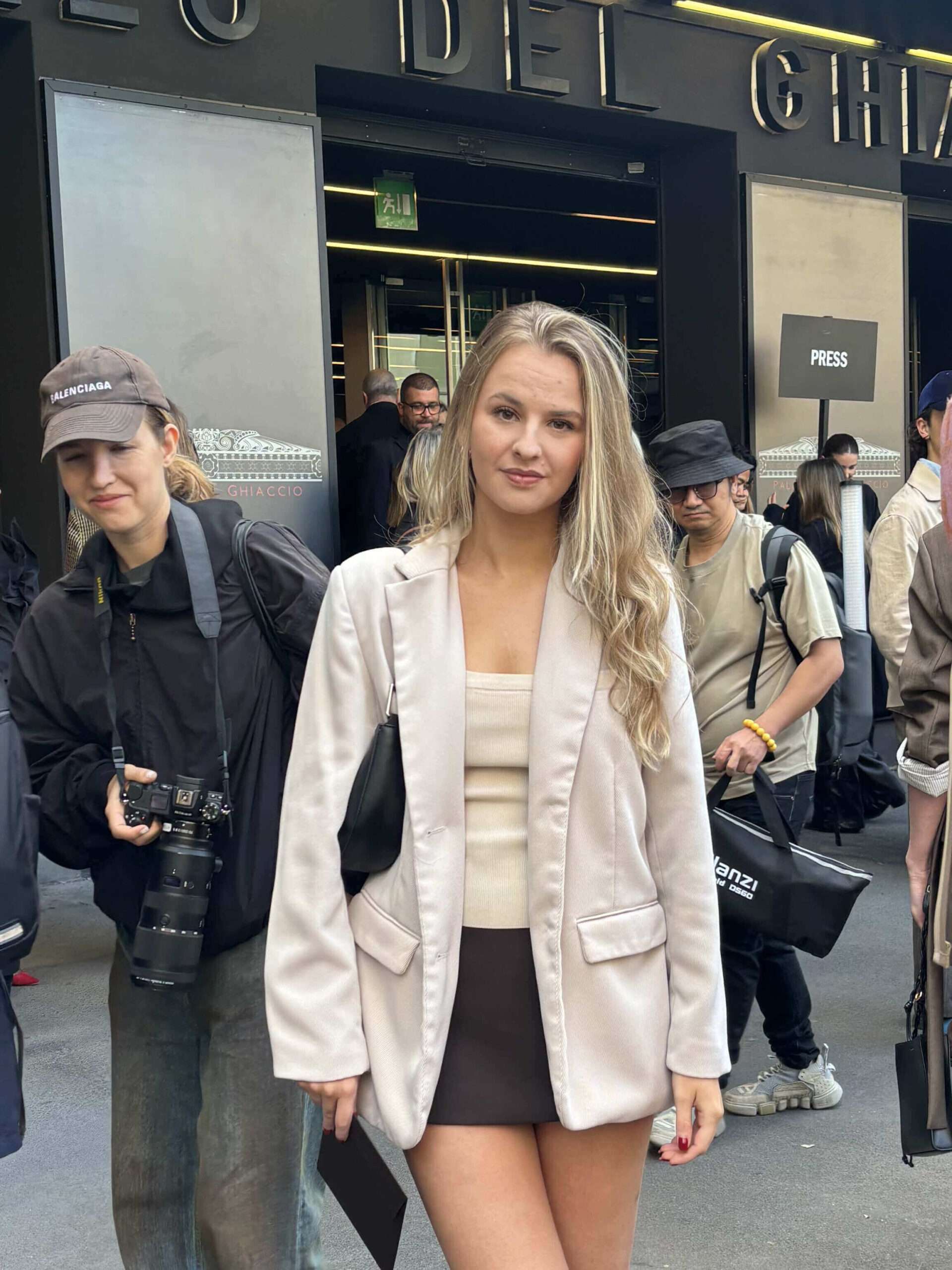
As part of the Morning Lazziness series highlighting empowering women who are making a remarkable impact with their ideas, I had the pleasure of interviewing Amy Cameron.
Amy Cameron is the founder and editor of STYLE26, a digital fashion magazine dedicated to bridging the gap between high-end and accessible style, serving readers of all backgrounds, body types, and budgets. With a background in fashion journalism and digital content, Amy launched STYLE26 during a challenging freelance period—a decision that became one of the best of her career.
In this interview, she delves into the challenges, successes, and wisdom she has gained from over a decade of transforming online businesses.
What inspired your leap into entrepreneurship, and what personal experiences sparked the idea behind your current venture?
I’ve wanted to work in fashion publishing since I was a teenager. It’s cliche but I grew up watching The Devil Wears Prada and Ugly Betty and knew that that is what I was meant to be doing – that passion has never left me. Starting my own fashion magazine was always a dream, but I hadn’t expected to do it so early in my career. But after leaving my full-time job to become a freelancer, I found that it was becoming increasingly difficult to gain consistent work. So I thought, if I can’t break into the system, why not create my own? I needed an outlet to write what I wanted to write and to keep me busy when I was between jobs. And so, STYLE26 was born.
What core problem does your business solve, particularly for women or underserved communities, and how does your approach stand out in today’s competitive space?
I find that many fashion publications target one specific demographic – usually either mid-range or high end and as someone who buys into both, I wanted my publication to reflect that. It’s also incredibly important to me to represent all women. No matter their age, race, size, income, or how much they already know about fashion. Whether you’re following the latest trends, learning how best to dress for your body shape, or simply interested in the latest fashion news, I want STYLE26 to be a safe, inclusive space where everyone feels seen and welcome.
What were some of the toughest obstacles you faced early in your journey as a woman entrepreneur, and how did you navigate through them?
One of the toughest obstacles I faced early on, and often still do, is imposter syndrome. Especially being relatively young and new to entrepreneurship. It’s easy to question if you are “qualified” enough to be starting something on your own. And I would often get invited to events, surrounded by so many influential people in the industry and just think “why am I here? They must have gotten me confused with someone else.” But I had to learn that I have a perspective and a drive to begin and that is enough. I have built confidence and trust in myself along the way, but as with everything, it’s still a work in progress.
Also as a solo founder without funding, one of the biggest challenges was balancing ambition with limited resources. Starting something from scratch without a team or big budget means I have to wear every hat – writer, editor, web designer, social media marketer. It gets overwhelming at times, but it has taught me resilience and how to make the most of what I have.
When the going gets tough, what keeps you grounded and motivated to keep pushing forward?
That there is nothing else I want to do. Despite the challenges and the many, many breakdowns, there is nothing I would rather be talking about all day than fashion. It’s what my younger self wanted to do, and if I ever have moments of doubt, I think of her and think that I cannot let her down.
What daily habits or non-negotiable routines help you stay focused, creatively energized, and balanced as a founder?
As much as I love working, I have to prioritise rest in order to feel inspired. Otherwise, I reach a point of burnout, and then nothing gets done. Even if it’s half an hour in the morning to read a book or take a walk at lunchtime.
What branding or marketing decision had the biggest impact in elevating your business and building trust with your audience?
I think that I treated it as a serious publication from the start rather than just a hobby. I wanted a professional-looking logo, high-quality images, and a polished tone of voice – everything you would expect from a major fashion publication. I wanted to create a strong and professional-looking identity so that readers knew they were engaging with something credible.
How do you personally define success, not just as a business owner, but as a woman living a purpose-driven life?
For me, being happy means success. I am very lucky to love what I do and that it fulfills me. Going viral or making millions sounds amazing on paper, but none of that matters if you’re miserable or disconnected from your purpose.
Can you share a mistake or misstep that taught you a lesson you still carry with you today?
Early on, I made the mistake of relying too heavily on one form of marketing – Pinterest, specifically. I was seeing great success with it; at one point, nearly 90% of my website traffic came from there. Because it was working, it felt natural to keep pouring all my time and energy into it. But I quickly learned that putting all your eggs in one basket is risky – one change in the Pinterest algorithm was all it took for my traffic to plummet overnight. It taught me a valuable lesson about the importance of diversification – not just in marketing, but in any area of business. It’s crucial to build multiple streams of visibility and not depend entirely on one platform or channel. It helps make your platform more sustainable in the long term.
What’s your best advice for women just starting out—especially first-time entrepreneurs feeling overwhelmed or unsure of their next steps?
It sounds like an obvious answer but my best advice is to take the leap and just do it. It’s so easy to get stuck in a cycle of overthinking. I am guilty of that myself, but honestly, what is the worst that can happen? You try something and it doesn’t work. That’s rubbish, but if you never start in the first place, then it has already failed. I used to think I had to wait for the perfect time to start, that I needed to know everything first. But the truth is you are always going to be learning as you go, so there is never a right time.
How do you approach risk and innovation, especially when breaking new ground in a male-dominated or fast-changing industry?
Breaking new ground in an already saturated industry is something I have struggled with. I felt the pressure to come up with something completely new and ground-breaking and thought that if I didn’t, my magazine would fail. But I have to remind myself that my voice in itself is unique and even if I am covering the same topic as another publication, the way I tell stories, the angles I choose, and the values I uphold make STYLE26 distinct.
What are the top mindset shifts or personal practices that helped you overcome self-doubt and grow your confidence as a woman entrepreneur?
I have a notes page where I jot down all my wins, even the very small ones, so that I can look back at how far I’ve come. It helps to remind me that I am on the right track.
Connecting with people in the industry also helps me. It’s amazing to know how many very successful people still experience self-doubt, and it makes me feel like I am not alone.
Taking time away from social media is also a big one. Social media can be great but it’s so easy to compare yourself to others and feel like you’re not doing enough. I find that when I take a break from it, I feel much more confident in trusting my own abilities rather than second-guessing myself because I am comparing myself to someone who is doing it differently.
If you could spark a global movement through your work, what would it be—and why is that mission meaningful to you?
One of the things I dislike the most about the fashion industry is the expectation to work for free just to get your foot in the door. It’s become normalised that even if you have a degree, solid skills, and experience, you still need to “pay your dues,” often for years, through unpaid or severely underpaid work. It makes breaking into an already very competitive industry even harder. Especially for those who come from less privileged backgrounds who can’t afford to work unpaid. One thing I promised myself when I started STYLE26 was that I wouldn’t let someone work for me unless I could afford to pay them. I would never want to take advantage of someone’s time and passion just to help my business grow. I’ve been on the other end of it, and it’s not nice. I’m not by any means the only founder to do this, but I hope that if enough have this mindset, then this expectation may shift. It could open the industry up to so many more creative voices.
Where can our audience connect with you, explore your work, or follow your entrepreneurial journey online?
You can read and subscribe to STYLE26 and follow me on Instagram.
